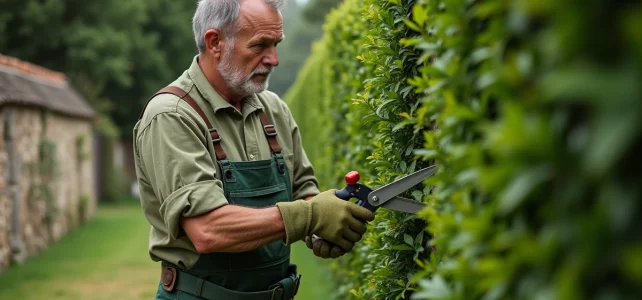
A hedge of privet that becomes bare at the base after three years of flat trimming is the most common problem encountered when arriving in a garden. The cause is almost never a lack of fertilizer or poor soil. It is the cutting technique, and more specifically the angle given to the blade, that determines whether the foliage will remain dense or eventually thin out.
The trimming of hedges relies on a few precise actions that most amateur gardeners neglect, due to a lack of knowledge.
Trapezoidal trimming: the shape that guarantees dense foliage
We often refer to “angled trimming,” but the exact technical term is trapezoidal trimming. The principle: the base of the hedge remains wider than the top. This slightly flared profile allows light to reach the lower branches, which are the first to become bare when the hedge is trimmed in a strict rectangle.
Specifically, we aim for a gap of a few centimeters between the width of the top and that of the base. On a cherry laurel or photinia hedge, this gap is sufficient to maintain compact vegetation down to the ground. On a yew or boxwood, the shape can be tighter because these species tolerate shade better.
The classic mistake is to trim the hedge perfectly vertical, or even slightly flared upwards. This results in a “green wall” whose base hollows out in two or three seasons. The practical guides available on sculpte-haie.com detail this mechanism for each type of shrub.

Adjusting trimming height to soil water stress
Since the recurring drought episodes observed in recent years, several agricultural chambers recommend adjusting the trimming height to the soil’s water reserve. In Mediterranean areas, in particular, the guideline is to gradually raise the minimum height of hedges and limit severe cuts at the end of summer.
The reasoning is simple. A close trim forces the shrub to mobilize its reserves to produce new shoots. If the soil is dry, this energy expenditure can lead to partial decline, or even the death of the younger plants.
When to trim without risking water stress
It is preferable to trim the hedge in spring (March-April depending on the region) and at the end of summer (September), when temperatures drop and rains resume. Between these two windows, any heavy intervention should be avoided.
- In spring, sap rises and the healing of cuts is rapid, which limits the entry of pathogens into the branches.
- In September, growth naturally slows down, and a light trim helps to set the shape before winter.
- In mid-summer (July-August), we limit ourselves to removing isolated suckers, without touching the overall structure.
Returns vary according to species and soils, but this schedule works for the majority of hedges composed of common evergreens (laurel, thuja, Leyland cypress).
Strict hedge or free hedge: a choice that changes maintenance
CAUE networks have observed a sharp decline in strict “green wall” trimmings in recent private garden projects. The trend is towards mixed hedges, slightly free, composed of several species of shrubs. These hedges require fewer passes per year and are more resistant to drought.
In practice, a strict hedge (thuja, laurel trimmed to a line) requires at least two trims per year to maintain a neat appearance. A free hedge made up of varied shrubs (viburnum, dogwood, spindle) only needs an annual shaping trim, sometimes supplemented by occasional pruning.
Consequences for tool choice
For a strict hedge, a long-blade hedge trimmer (over 50 cm) is used to achieve flat and even surfaces. For a free hedge, a two-handed pruner and shears are sufficient in most cases, as we intervene branch by branch rather than on a uniform cutting plane.
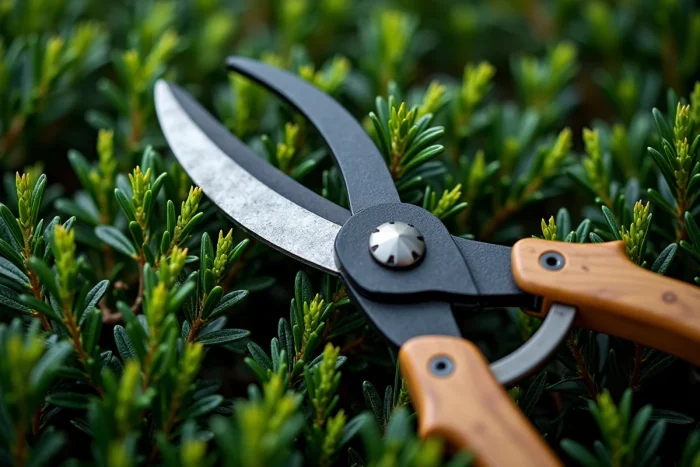
Common trimming mistakes on evergreen shrubs
Three actions consistently appear in poorly maintained hedges, and they can be easily corrected once identified.
- Cutting beyond the green wood on a thuja or cypress: these conifers do not regrow on brown wood. If trimmed too short, permanent gaps are created in the hedge.
- Trimming to the exact same height every year without allowing the hedge to gain a few centimeters: the terminal buds are those that stimulate lateral branching. By consistently removing them at the same point, we weaken the density.
- Neglecting the base in favor of the top: there is a tendency to focus on the upper line to keep it straight, forgetting to clear the lower branches that lack light.
On deciduous shrubs (hornbeam, beech), the margin for error is wider. These species regrow from old wood, allowing for more severe rejuvenation trims without the risk of permanent loss.
Regulations and periods of trimming prohibition
The BCAE 8 conditionality of the CAP 2023-2027 strengthens the protection of hedges and groves in agricultural areas. For individuals, obligations vary according to municipal orders, but a national rule applies: trimming is prohibited during the nesting period, generally from early March to the end of August for heavy interventions on hedges in rural areas.
In urban areas, subdivision regulations or PLUs sometimes set maximum heights and planting distances from property boundaries. Before trimming a boundary hedge, it is advisable to check these constraints with the town hall to avoid neighborhood disputes.
A final often overlooked point: trimming waste. Several municipalities now require on-site shredding or composting and prohibit open-air burning. Shredding the residues and spreading them as mulch at the base of the hedge remains the most coherent solution, as it returns organic matter directly where the shrub needs it.