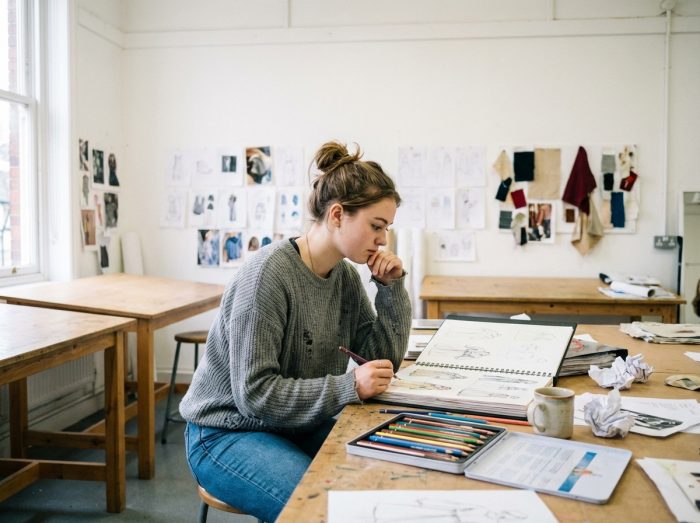
Applied art schools admit candidates from very different backgrounds each year, but an intermediate step is becoming increasingly necessary: the preparatory year. Some institutions make it mandatory, while others dismiss it in favor of direct selection based on portfolios or interviews.
Understanding the Different Paths in Applied Arts After High School
After high school, access to training in applied arts takes more varied paths than one might imagine. For those who have not followed a specialized track, the famous foundation year is essential: a necessary step to acquire solid tools before being able to join a design school or an art school. Some choose the DN MADE, a public three-year program, while others prefer a BTS in graphic design, which is shorter and more focused on practical skills.
There are also preparatory classes, public or private, that serve as a springboard to the entrance exams of higher art schools in Paris, Lyon, and Nantes. These programs provide time to sharpen one’s perspective, refine methods, and lay the groundwork for a personal artistic language. It is often during these years that a solid portfolio is built, a key element when entering national higher schools.
Throughout this journey, future candidates encounter several diplomas: the national diploma, the license in plastic arts, or the national diploma in plastic expression. Each has its own codes, rhythms, and requirements. The entrance exams for art schools demand a culture, a critical eye, and an artistic involvement that are rarely present right after high school.
In this context, the value of a preparatory year in design is evident for many. This step allows for clarifying one’s project, refining the understanding of jury expectations, and stepping confidently into the world of art and design professions. After such a year, candidates approach the selections of prestigious schools with more confidence, better equipped to carve out their place in the French creative scene.
Design Preparatory Year: What Advantages for Successfully Entering a Prestigious School?
For many high school graduates, the design preparatory year acts as an accelerator. It is the ideal ground to test, understand, and progress. On a daily basis, through creation workshops, discovering plastic arts, and meeting professionals, a solid creative book emerges, a decisive asset during entrance exams for schools.
This environment allows for a concrete confrontation with the diversity of expectations from higher art schools. The oral motivation interviews require more than just a simple passion: one must know how to defend their project, argue, and give meaning to their approach. Working on a portfolio enriched by a year of research and experiences gives one the means to stand out. One learns to highlight choices, present a application file that holds up, and embrace a unique artistic vision.
Often, this training period concludes with a end-of-year project, sometimes complemented by an internship. This is an opportunity to make direct contact with the reality of art and design professions. The teachings combine art history, contemporary practices, and visual communication: enough to build a foundation of references and adopt the codes of the sector. Whether in Paris or in the regions, the design preparatory year stands out as a pivotal moment for orientation, testing oneself, and asserting oneself before aiming for a recognized art school.

How to Choose the Training that Corresponds to Your Artistic Project
Choosing your training is neither a matter of chance nor simple intuition. To find the right path, one must study the options in detail and take the time to understand their own ambitions. Opting for a design preparatory class or an art preparatory class primarily depends on the project one nurtures: some want to orient themselves towards art direction, while others look towards visual communication, 3D animation, or graphic design. The choice between DN MADE, BTS in graphic design, and Bachelor in design requires examining the pedagogy, rhythm, and the emphasis placed on practice, theory, and creation.
To help navigate this, here are some steps that facilitate the choice:
- Meet teachers and talk with former students to understand the atmosphere and level of support offered.
- Study the end-of-year projects completed to gauge the diversity of profiles supported, whether a general high school graduate or a passionate self-taught individual.
- Consider the balance between specialization, towards graphic design, illustration, fashion, audiovisual, and multidisciplinary openness.
Location also plays a role: Paris, Toulouse, or other cities offer different environments, sometimes closely connected to the professional world. It is useful to check the integration rate into art and design professions and the recognition of the national diploma awarded. Finally, the quality of support in building the portfolio and preparing for the entrance exams of higher schools can make all the difference. A well-chosen preparatory year paves the way towards a path aligned with your artistic ambition.
Ultimately, the design preparatory year is not just a simple gateway: it is the place where reference points are forged, where tools are refined, and where the project takes shape. What seemed unattainable after high school suddenly becomes tangible, within reach. Taking this time is already opening the door to prestigious schools… and often, to one’s own creativity.