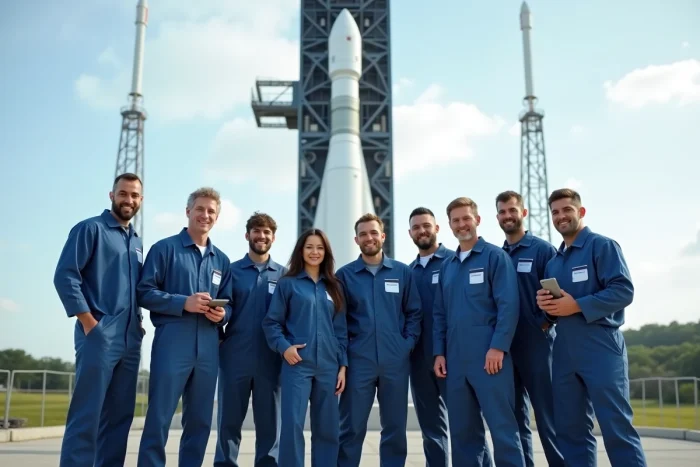
The ability to place a satellite into orbit relies on mastering an independent launcher, a property that few states can claim despite the proliferation of space projects. To date, fewer than fifteen countries possess this technological and industrial autonomy, while many nations still depend on foreign services or international cooperation.
As the space competition intensifies, some states are seeking to catch up. Ambitions are revealed through record investments, political announcements, and technological demonstrations. Behind the spectacular images of liftoff, a battle for sovereignty and prestige is taking place, where each launch becomes a symbol of national expertise.
Which countries currently have the capacity to launch satellites into space?
A handful of nations hold the capacity to send a satellite into orbit, the result of years of innovation, industrial bets, and strong political will. To get an accurate idea, one only needs to consult the revealing list of countries capable of launching satellites. On a global scale, it is a small league, jealous of its autonomy and mastery of cutting-edge technologies.
The United States, Russia, and China shape the space landscape, bolstered by a legacy dating back to the Cold War era. France established itself in the 1960s, providing Europe with a beginning of autonomy on the international stage. Over the decades, other states have joined this circle: Japan, India, Israel, North Korea, South Korea… All stand out with their own launchers and strategies.
The historic site of Baikonur illustrates a paradox: Kazakhstan hosts one of the most famous space bases in the world but has never acquired mastery of a national launcher. Thus, space independence is not merely a geographical address; it relies on the ability to control the entire cycle, from the development of the launcher to its operational implementation.
In short, being autonomous in launching satellites remains the privilege of only a few states. This small number reflects less a lack of ambition than a ruthless industrial and technological reality, where sovereignty, expertise, and political power intertwine.
Overview of strategies and innovations of space powers
Maintaining a place among space nations involves specific choices. Each country works with its resources, objectives, and alliances, creating a mosaic of strategies tailored to each context.
France, supported by CNES and the European Space Agency, has managed to build a dynamic sector that fuels numerous cooperations, whether for projects around the International Space Station or satellites for security. This European involvement does not erase the uniqueness of each nation but creates a collective power dynamic in the global market.
In the United States, space conquest is now being written by multiple hands. NASA retains a central role but must contend with the rise of SpaceX, Blue Origin, and other newcomers from the private sector. This shift disrupts the old guard: now, it is an entire ecosystem that drives innovation, under the watchful and strategic eye of the federal government.
Asia is not lagging behind: South Korea is accelerating, while North Korea continues its demonstrations. Each of these rockets launched attracts attention, as they reflect both technological advancements and a desire to influence regional geopolitics.
In low Earth orbit, cooperation exists, particularly through the International Space Station. But behind the scenes, competition and influence games continue. The balance is precarious, and each technological advancement disrupts the hierarchy.

Understanding launch bases and the different types of rockets: essential resources and benchmarks
Accessing space is not just about having a rocket. A complex chain unfolds: large-scale infrastructures are needed to accommodate sometimes gigantic launchers. Launch bases are the strategic showcase of each country. For example, the Guiana Space Centre in Kourou serves as the epicenter of European launches thanks to technical choices combined with ideal geography. Baikonur in Kazakhstan retains a mythical dimension, while Cape Canaveral, Tanegashima, or Taiyuan remind us that the game is now global.
The launchers themselves vary depending on the mission at hand. Some, designed for heavy payloads and long distances, are associated with great feats like lunar exploration. Other models, tailored for low Earth orbit satellites, prioritize flexibility and the multiplication of deployments. Finally, sounding rockets mark experimentation and breakthrough testing. Each mission has its own launcher and constraints, including payload weight, type of orbit, and safety requirements specific to each site.
To provide a precise overview, here are some flagship examples among the main launch sites, pillars of access to space:
- Kourou (France, Guiana): the reference platform for European launches, serving institutional and commercial markets.
- Baikonur (Kazakhstan): the origin point of the first human flight into space, a site rich in history.
- Cape Canaveral (Florida): a true center of gravity for the American space program.
- Tanegashima and Kagoshima (Japan), Taiyuan (China), as well as Ukraine and Kenya: numerous sites that illustrate the diversity of a sector in full reconfiguration.
Owning and mastering these infrastructures, while developing one’s own launchers, gives a lasting advantage to any nation that aspires to leave its mark on space conquest. Today, each flight leaves a trace on the map of a world governed as much by the dream of orbit as by the interplay of powers.