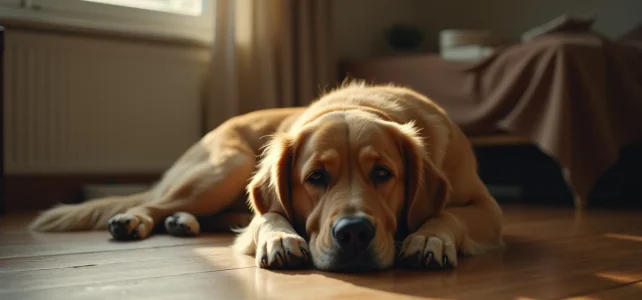
Canine dysthymia refers to a mood disorder in which the animal alternates between phases of hyperactivity and episodes of apathy, sometimes with disproportionate outbursts of aggression. Often compared to human bipolar disorders, this pathology remains poorly defined in veterinary medicine. The diagnostic criteria are not consensual, and most clinical cases are still described under broader labels: anxiety disorders, impulsive aggression, compulsive disorders.
Canine dysthymia and diagnostic ambiguity: why the term is problematic
Popular articles present dysthymia as a well-defined entity, sometimes summarized by the expression “bipolar dog.” The clinical reality is more blurred. Recent veterinary behavior reviews emphasize that canine dysthymia is not a stabilized nosological entity. No biomarker, no standardized score allows it to be distinguished with certainty from severe anxiety disorders or chronic compulsive states.
The diagnosis relies on behavioral observation and the exclusion of other pathologies (neurological, endocrine, painful). A veterinary behaviorist relies on the owner’s description of the episodes, their frequency, and triggers, often without an identifiable stimulus. This process takes time and does not always lead to certainty, which the available data still cannot resolve.
To understand dysthymia in dogs, one must first accept this limitation: the term likely covers a spectrum of disorders rather than a single disease.
Warning signs in dogs: distinguishing a mood disorder from an education problem
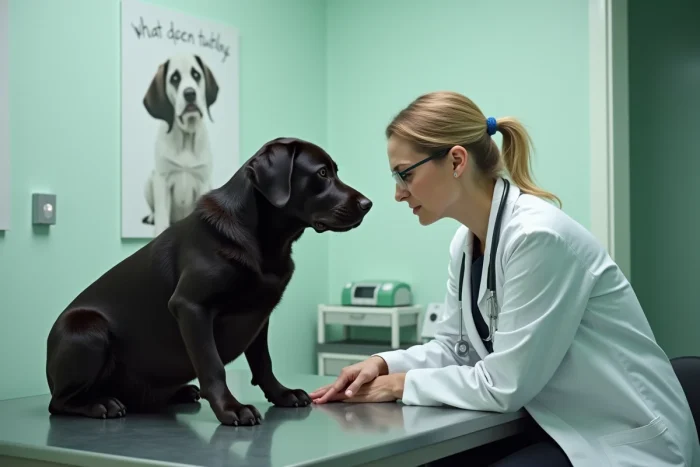
The confusion between a deep behavioral disorder and a simple lack of training often delays intervention. A dog that destroys objects in the absence of its owner may suffer from separation anxiety. A dog that growls when disturbed on the couch may lack boundaries. Dysthymia, on the other hand, manifests through abrupt and repeated changes in emotional state, with no clear relation to the environment.
Episodes most often appear between one and four years of age, sometimes in an animal whose behavior had previously been completely normal. It is this sudden break that alerts owners.
Here are the signals that, when combined, should lead to a specialized consultation:
- Phases of intense hyper-excitement (fixed gaze, hyper-vigilance, disorganized motor activity) alternating with periods of prostration or social withdrawal, without an identifiable external cause
- Disproportionate fear or aggression reactions to a benign stimulus (everyday noise, slow movement from the owner), followed by a return to normal within a few minutes or hours
- A change in eating or sleeping habits unrelated to any change in the living environment, persisting for several weeks
An isolated behavior is not sufficient. It is the recurrence and alternation of phases that distinguish dysthymia from a one-off episode of stress or fear.
Genetic predispositions and working lines: what research suggests without confirming
Several studies in applied ethology and canine genetics mention links between mood disorders and certain lines strongly selected for performance. Working dogs, sport dogs: selection for reactivity and physical endurance could, as a side effect, promote abnormal emotional reactivity and difficulties in adapting to chronic stress.
However, this research speaks of trends, not proven causality. No breed is officially “predisposed” to dysthymia. Field reports vary on this point: some veterinary behaviorists report cases concentrated in shepherd or molossoid breeds, while others observe the disorder in companion dogs without a history of sport selection.

This gap between clinical intuition and the lack of robust data illustrates a broader problem. Research on canine psychiatric disorders lacks sufficient cohorts to establish reliable correlations. Existing studies focus on small samples, with variable protocols from one laboratory to another.
Veterinary management of dysthymia: psychotropics and treatment limitations
The treatment of canine dysthymia primarily relies on the prescription of psychotropics, particularly mood stabilizers. Follow-up requires a veterinarian trained in behavioral medicine, capable of adjusting doses and monitoring side effects over time. This is not a short-term treatment: management often extends over several months, sometimes for life.
Behavioral therapy alone is generally not sufficient. Unlike a classic anxiety disorder where gradual desensitization can yield results, dysthymia involves a neurochemical imbalance that education does not correct. Training and environmental adjustments (reducing stressors, predictable routines) play a supportive role, not a solution.
Another difficulty: the response to treatment varies greatly from one animal to another. Some dogs stabilize quickly, while others show only partial improvement. Owners must be prepared for this uncertainty and for regular follow-up with their veterinary behaviorist.
The question of quality of life also arises for severe cases. A dog whose episodes remain frequent despite treatment lives in a state of chronic stress. Decisions in these situations require in-depth discussions between the owner and the practitioner, with no universal answers.
Canine dysthymia remains a disorder whose scientific contours are still under construction. Identifying signals early, consulting a veterinary behavior specialist, and accepting that medication may be necessary in the long term are the three concrete levers available to owners facing this diagnosis.