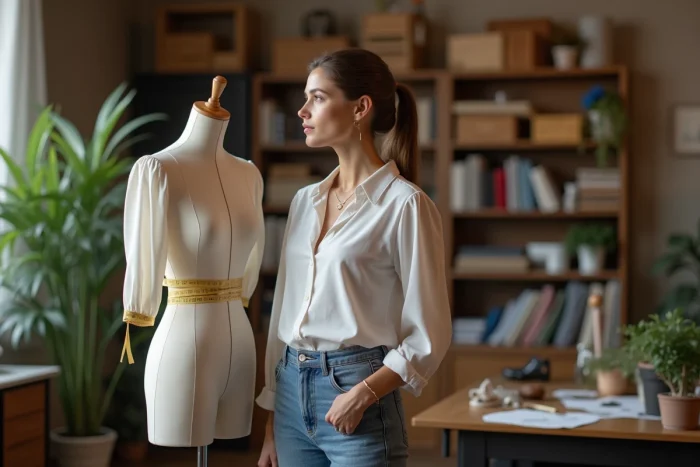
Numbers like magic words. 90-60-90, three measurements that have left their mark on generations, without ever considering the multiple realities of the female body. Since the 1960s, international modeling contests have displayed this standard as an essential passport. No scientific method, no medical justification behind these numbers, just the fashion industry’s desire to set a norm, a norm tailored to its own needs, far from any bodily diversity.
This triptych has risen to the status of a reference, although it has never had any relation to the authentic variety of female silhouettes. Some agencies, without batting an eye, required models to conform to these measurements, and no matter their talent or charisma, any candidate who deviated from them was automatically dismissed.
90-60-90: where do these legendary numbers really come from?
In the beginning, the famous 90-60-90 was not a universal truth. In the 1950s-1960s, it was the clothing workshops and the ready-to-wear industry that endorsed this hourglass silhouette, supposedly flattering the majority… on paper. The idea took hold, encouraged by the rise of women’s magazines and the emergence of icons like Marilyn Monroe and Jayne Mansfield. Their curves became the norm to follow, permanently imprinting the triptych in the collective imagination.
The late 1950s marked another turning point: Barbie, launched in 1959, embodied this fantasy of the ideal morphology, with a defined bust, a slim waist, and rounded hips. This toy, an object of aspiration, spread a stylized version of femininity. Women’s ready-to-wear organized itself around these measurements, facilitating mass production, but in the process excluding the majority of European women, whose morphology often strayed far from the famous hourglass.
To better understand the significance of these numbers, one must look at how the meaning of 90 60 90 has transcended pure technique. These measurements have become the receptacle for all expectations and projections surrounding female beauty. Media, advertising, industry, all have relayed the message, turning these numbers into a kind of myth. Actresses like Sophia Loren and Jane Fonda each extended the aura of this ideal in their own way. However, recent research shows that ideal measurements have always varied according to cultures, eras, and societies.
A look at the history of art confirms this: the Venus de Milo, the paintings of Rubens, these works celebrate other forms, other balances, far from 90-60-90. The preconceived notions of beauty are, at their core, merely a shifting reflection of an era and its desires.
Between social pressure and the quest for perfection: how the myth shapes our views on the body
The imprint of 90-60-90 does not stop at fashion or magazines. This standard has seeped everywhere, becoming a sort of implicit reference for entire generations. The pressure to conform to this mold has intensified over time, fueled by repeated images of star models like Kate Moss, Naomi Campbell, Claudia Schiffer, or Cindy Crawford. Today, Instagram and TikTok amplify the effect: models, often retouched, flood screens and reinforce the idea that a body’s value can be measured.
The consequences are not long in coming. Studies point to the rise of eating disorders, a weakening of mental health, and the normalized recourse to cosmetic surgery. In France and Italy, legislation now regulates the use of excessively thin models, an institutional response to very real excesses. Yet, the 90-60-90 norm remains entrenched, slipping into habits, whether it’s about choosing clothing or monitoring one’s plate.
But the landscape is changing. New faces, new narratives are emerging. Ashley Graham champions self-acceptance, Winnie Harlow embodies body diversity, and Jill Kortleve advocates for untouched beauty. The female ideal is cracking: the plurality of bodies is beginning to gain ground, both in public debate and in the media.
Towards a plural beauty: deconstructing norms to finally accept ourselves as we are
In the face of old standards, body diversity asserts itself as a healthy response. Collective movements, such as body positivity, challenge the relevance of the unique 90-60-90 model. The visibility of personalities like Ashley Graham, Winnie Harlow, and Jill Kortleve disrupts the codes. Their presence in the fashion industry and in the media challenges the authority of the centimeter and the gram, and promotes a more authentic self-acceptance.
Let’s look at how some brands are embracing this evolution. Brands like Etam, or inclusive beauty players like Fenty Beauty, highlight a multitude of silhouettes and skin tones. Their campaigns celebrate diverse ages, skin colors, and body types. This dynamic, praised by many consumers, is also based on a scientific reality: health is not limited to wearing a standard size, nor to confining oneself to measurements dictated by the industry.
The shift is even visible in the world of video games, where heroines like Lara Croft or Samus Aran see their appearance evolve over generations and expectations. Today, the definition of beauty is being constructed by multiple voices: artists, brands, researchers, activists. The field of possibilities is gradually opening up. We are moving away from the unique myth to allow diversity, the real diversity that cannot be contained within any precise measurement.